Blue Carbon Academy opens doors for future leaders
This summer, the University of St Andrews brought together students, scientists, and policy experts from around the world for the very first Blue Carbon Academy – a new programme designed not just to teach, but to inspire and equip the next generation of leaders in tackling marine climate (and linked biodiversity) challenges.
Coordinated through the University’s Global Office and led by Professor William Austin with support from Drs Craig Smeaton and George Biddulph, the Academy was inspired by, and contributes towards, the United Nations Decade of Ocean Science for Sustainable Development (2021–2030), whose guiding motto is “the science we need for the ocean we want.”
With support from the World Wide Fund for Nature (WWF-UK), the UK Government, and the UN’s Ocean Decade Programme for Blue Carbon in the Global Ocean (GO-BC), the programme offered world-class training and helped build a global network of collaborators dedicated to coastal ecosystem conservation.
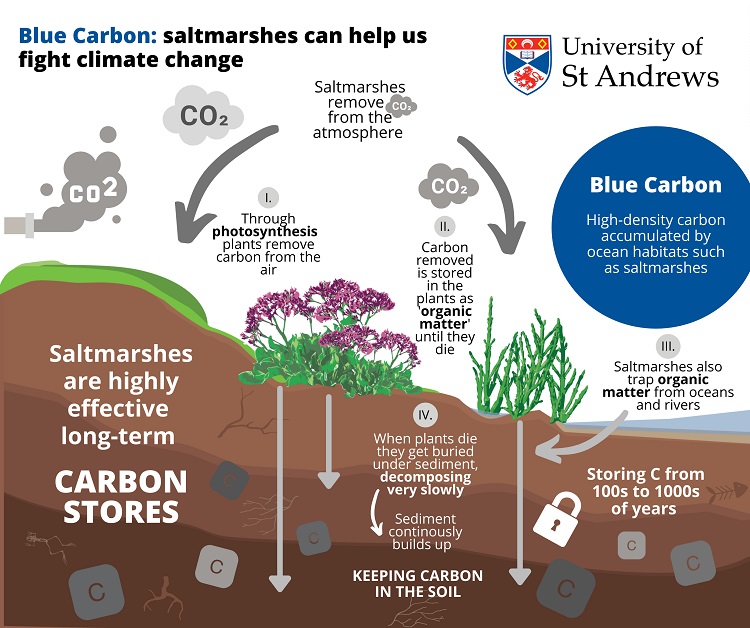
Blue carbon – the carbon stored in coastal habitats like mangroves, saltmarshes, and seagrasses – has quickly moved from a scientific concept to a crucial part of the fight against climate change and nature loss. These ecosystems not only lock away carbon but also protect communities from rising seas, provide homes for marine life, and support local economies.
The Academy gave participants a deep dive into both the science and policy behind blue carbon, helping them develop the confidence and skills needed to influence climate action and conservation efforts worldwide.
“Blue carbon ecosystems are vital natural allies in tackling climate change. They protect vulnerable coastlines, support biodiversity, food security, and local livelihoods. Hosting the Blue Carbon Academy here at St Andrews this summer was a real privilege. The passion and commitment these young scholars brought to the programme were truly inspiring,” said Bill.
Throughout the programme, held over two weeks from late June into July, students were immersed in local fieldwork, laboratory-based analyses and worked hands-on with real data and learnt how to communicate their findings to policymakers. From mastering tools like QGIS and R to debating current conservation challenges, participants gained skills they can apply directly in their research and future careers.
As part of the course, students took part in a field visit to the RSPB Skinflats Reserve located on the southern shore of the Firth of Forth, in Scotland, near the village of Kincardine in Fife, a coastal wetland area known for its saltmarshes and mudflats, important for birdlife and conservation efforts.
Here, the group worked alongside conservation professionals to explore saltmarsh restoration and managed realignment in action. This gave them a valuable opportunity to collect primary data, observe habitat management up close, and connect classroom learning with real-world conservation efforts.
Participant Shrutee Jain, from India, said of the experience: “I had an incredible learning time, I hope to carry forward the learnings and share them with the same excitement, dedication and warmth you have shared with us.”
By blending cutting-edge science, policy insight, and international collaboration, the Blue Carbon Academy aims to be a stepping stone for those ready to make a real difference for our oceans and coastal ecosystems. The hope is that the connections made here will continue to spark change long after the programme ends.
The course runs as part of the University’s wider St Andrews Summer Study programme, and applications for next summer are expected to open in Autumn 2025. You can find more information about the course on the Blue Carbon webpages.
Category Sustainability