Hiding in plain sight: How leafy costumes evolved to trick predators
New research from the University of St Andrews uncovered a surprising evolutionary mechanism behind some animals’ trick of hiding in plain sight from predators.
Some animals have a remarkable ability to masquerade as inanimate objects like leaves, sticks and stones, causing predators to pass them by.
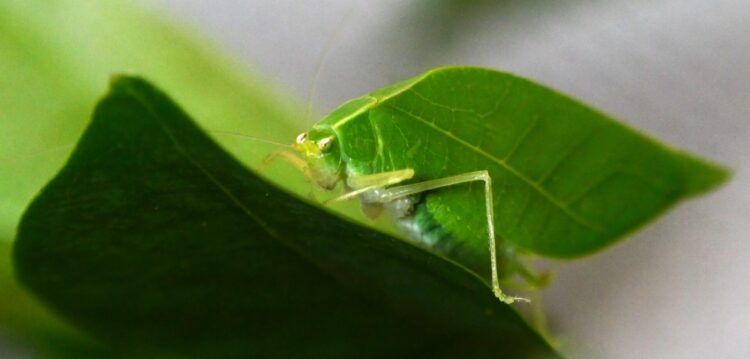
Published in PLoS Biology, researchers from the Centre for Biological Diversity at St Andrews studied katydids (commonly known as bush crickets) to discover how some species’ wings evolved an extraordinary resemblance to plant leaves.
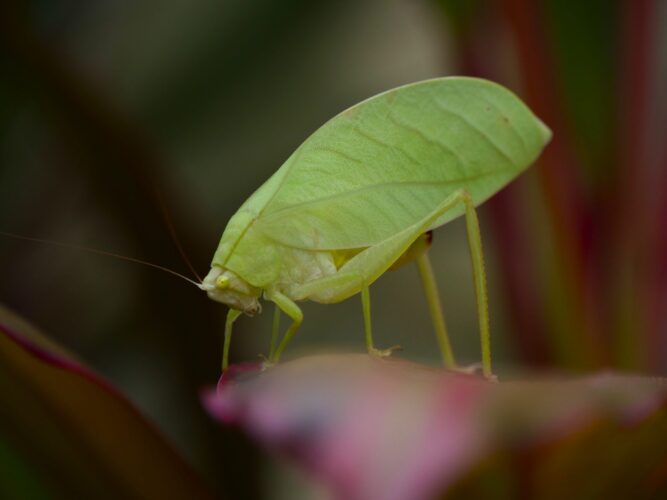
The researchers undertook predation experiments in nature and found that hungry birds are only tricked when wings masquerading as leaves have just the right colour – green – and the right shape – oval. Either trait on its own gave no advantage.
Then they compared wing shape and size across 58 tropical katydid species to test how leaf masquerade evolved over millions of years. Surprisingly, green colour and leafy shape evolved simultaneously.
The results illuminate how complex “design” such as an uncanny resemblance to inanimate objects can evolve synergistically, not incrementally as is commonly assumed.
Dr Benito Wainwright, Research Fellow from the School of Biology, said; “Our works shows us how spectacularly specialised disguises can come about, allowing species to go completely unnoticed in environments where the struggle for survival from predators is at its most intense”
Professor Nathan Bailey, who co-authored the paper, said; “The natural world is full of incredible adaptations that beggar belief. This work on leafy katydids shows how the evolutionary mechanisms shaping those traits can seem improbable but turn out to be important.”
Category University news