Nuclear testing preserved in killer whale teeth
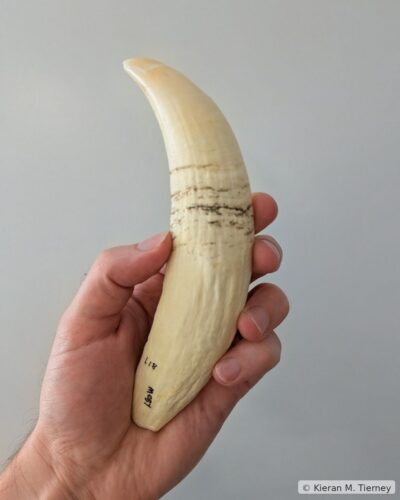
New research from the University of St Andrews, SUERC: Centre for the Isotope Sciences , University of Glasgow and National Museums Scotland has found fallout from nuclear weapons testing preserved in the teeth of sperm whales and killer whales which had stranded and died on Scotland’s coastline.
Published in Frontiers of Marine Science, authors used radiocarbon and stable isotopes of carbon and nitrogen to investigate the life histories recorded in these animals’ teeth.
Inside each whale tooth is a banded pattern of growth layers, like tree rings. Radiocarbon produced by atmospheric nuclear weapons testing in the mid-20th century provided a time marker that allowed researchers to test whether these growth layers were deposited annually in sperm and killer whales, while stable isotopes revealed changes in feeding ecology and habitat use.
One of the most striking animals was Lulu, a well-known female killer whale from Scotland’s West Coast Community that stranded on Tiree in 2016. Unlike the other animals, her tooth did not record the nuclear weapons-testing signal. Instead, it contained a civil-nuclear discharge signal from Sellafield confirming her long-term association with the west of Scotland.
This new work, applies a novel method to increase our certainty in stranded odontocete tooth ageing. It confirms the annual deposition of dentine in the sperm whales analysed and in one of the killer whales, but emphasises that counting growth layers may not be a reliable ageing method in older killer whales. Importantly, it also highlights that teeth can preserve a signal from civil nuclear-derived ¹4C, confirming that such variations in the environment are incorporated into animal tissues.
Dr Maeva Terrapon from the Sea Mammal Research Institute at the University of St Andrews who contributed to the research, said: “Whale teeth obtained from stranded individuals represent a fascinating and important tool to understand the diet of these animals across their lives and to estimate where they spent most of their time. These results provide a baseline to then learn about the ecology of the individuals that are still present in our waters. Our next step will involve using similar teeth and methods to look at the presence of pollutants and gain insights on potential exposure prior to their death.”
Category University news