Study reveals brain’s built-in distance tracker
Humans use lots of different types of information to make sure we don’t get lost. We can look out for familiar landmarks and use our sense of direction, but we can also estimate how far we have walked.
In new research from the University of St Andrews, published today in Current Biology, researchers from the School of Psychology and Neuroscience trained rats to run a specific distance to get a reward. They then recorded from individual cells in the brain’s navigation system as the rats performed the task. Previous studies have shown that some of these cells have very regular peaks of activity, approximately every 30cm, like a neural pedometer. St Andrews researchers then changed the task environment so that the peaks of activity were less regular and found that the rats’ ability to estimate distance got worse.
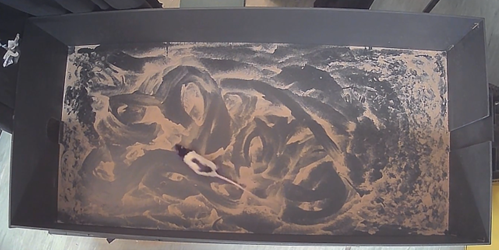
Rats take part in the trial
The regularity of the pedometer-like signal was correlated with accuracy of distance estimation, suggesting that this is the neural signal that allows us to keep track of how far we have walked.
Researchers then recreated the rat task for humans in the real world, building a 12.5m long environment in the St Andrews Students’ Union. Results showed that humans can also accurately judge distance and that the same environmental manipulation that distorts the pedometer in rats also makes humans worse at the task.
The measurements were recorded in the brain’s entorhinal cortex. This is one of the very first areas of the brain to be damaged in Alzheimer’s disease. This means that the distance estimation task that relies on the neural pedometer might be a useful tool for early diagnosis.
Professor James Ainge who led the study, said: “It is very exciting to link the ability to estimate distance with this regular pattern of activity in the entorhinal cortex. The fact that humans and rats show the same type of errors in distance estimation in different environments gives us confidence that the brain mechanisms are the same in both species.”
Category University news