Professor Mark Chaplain elected to Fellowship of the Royal Society
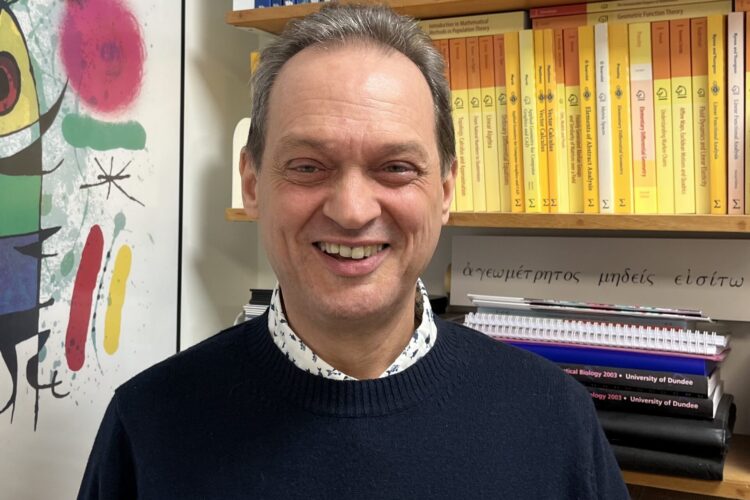
Professor Mark Chaplain, Gregory Chair of Applied Mathematics in the School of Mathematics and Statistics at St Andrews, has been elected to the Fellowship of the Royal Society, the UK’s national academy of sciences.
This year’s cohort of over 90 outstanding global researchers includes pioneers and leaders across a range of scientific fields, from astronomy and cancer research to mathematics and biotechnology.
Speaking of the honour, Mark said: “I am a little shocked but absolutely delighted at being elected to the Fellowship of the Royal Society. I am very grateful to the colleagues who nominated me and supported my nomination. It is a tremendous honour to have one’s work and research achievements recognised in this way.”
Mark’s main area of research is mathematical oncology – the development, study, analysis and computational simulation of multiscale mathematical models of cancer growth and treatment. He and his team have developed a number of quantitative and predictive mathematical models for key stages of tumour growth resulting in important insights into how different biochemical and mechanical processes interact. This approach has now evolved into a distinctive field of research in its own right, and Mark has this year just published a definitive textbook (Mathematical Oncology) with Springer Nature.
He has also helped develop models of chemotherapy treatment of cancer, focussing on cell-cycle dependent drugs, and also radiotherapy treatment and immunotherapy treatment.
His more recent work has focussed on modelling cancer invasion and metastasis using hybrid discrete-continuum approaches, and he has developed the first computational framework which models these important key processes of cancer spread. His long-term goal is to develop a virtual multiscale mathematical model of cancer – a cancer “digital twin”. This will have the potential to have a positive impact on patients suffering from cancer (as well as other diseases) through improved and optimized personalized clinical treatment.
Mark was elected Fellow of the Royal Society of Edinburgh in 2003 and member of The European Academy of Sciences in 2024. He was also awarded the Whitehead Prize of The London Mathematical Society for his research work on the mathematical modelling of cancer growth in 2000.
Sir Paul Nurse, President of the Royal Society, said: “I am delighted to welcome this newest group of exceptional scientists to the Fellowship of the Royal Society.
“Their contributions reflect the highest standards of scientific endeavour. Whether advancing our understanding of vaccines or exploring the transformative potential of mathematics and computation, their work exemplifies the enduring value of curiosity, creativity and rigorous inquiry.
“Our Fellowship is strengthened not only by individual distinction, but by the diversity of perspectives and experiences its members bring. This incoming cohort highlights the truly international character of contemporary science and underscores the vital role that plays in achieving breakthroughs that benefit us all.”
The Fellows and Foreign Members join the ranks of Stephen Hawking, Isaac Newton, Charles Darwin, James Clerk Maxwell, Albert Einstein, Lise Meitner, Subrahmanyan Chandrasekhar and Dorothy Hodgkin.
Category Awards