St Andrews smart solar panels and lens-less microscopes projects awarded funding
Two St Andrews professors have been awarded prestigious European Research Council grants. Professors Andrea Di Falco and Malte Gather have separately won Proof of Concept funding to take their respective projects from early-stage development to scalable, workable realities.
Professor Di Falco is developing a solar-cell-based optical neural network (ONN) designed for real-time, energy-efficient environmental monitoring and object recognition. It’s hoped the project will eliminate the need for conventional cameras and external power sources, significantly reducing energy consumption. The integration of metasurfaces will enable more accurate detection and recognition of objects based on light patterns and colours.
This project aims to meet the growing demand for sustainable, cost-effective environmental monitoring and establishes a foundation for future commercialization and global deployment.

Professor Andrea Di Falco
Professor Di Falco, said: “We’re excited to explore the potential of solar cells as intelligent sensors by integrating them with advanced photonic metasurfaces. This is a transformative step toward self-powered, scalable monitoring systems with applications from climate science to smart infrastructure.”
Professor Malthe Gather, also from the School of Physics and Astronomy, has secured an ERC Proof-of-Concept Grant to develop and validate a “lens-less” microscopy platform, integrating optical filters directly onto a camera chip to achieve multi-colour microscopy. Microscopy is a fundamental tool in biomedical research, pharmaceutical development, and clinical diagnostics, yet conventional systems remain costly, bulky, and impractical for scalable or portable applications. If successful, this platform will enable a highly compact and cost-effective imaging solution.
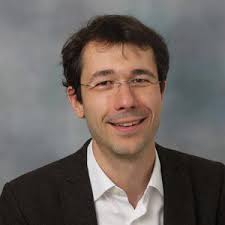
Professor Malte Gather
Professor Gather said: “The Proof of Concept funding scheme of the European Research Council is a very exciting opportunity to translate and validate some of our basic research for real world impact.”
The ERC, set up by the European Union in 2007, is the leading European funding organisation for excellent frontier research. It funds creative researchers of any nationality and age, to run projects based across Europe.
Category University news