RSE welcomes five new Fellows from St Andrews
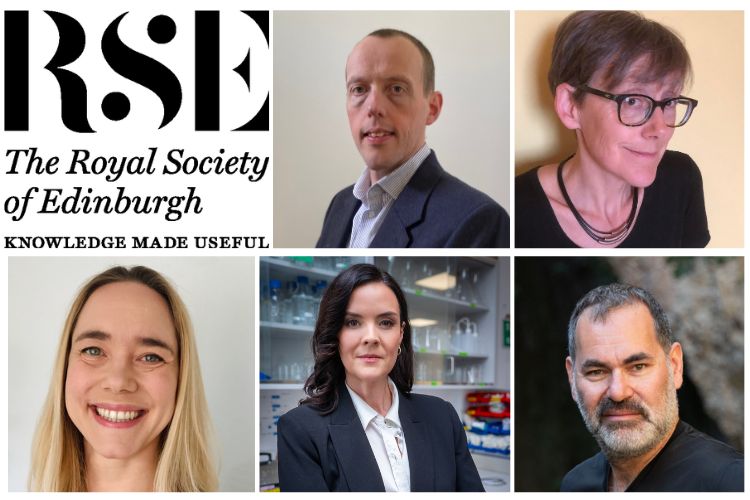
The Royal Society of Edinburgh (RSE), Scotland’s National Academy, today (April 7) announced 43 new Fellows from across the world of science, the arts, education, business and public life, including five Fellows from the University of St Andrews.
Newly-elected Fellows from St Andrews are: Professor Phil King in the School of Physics and Astronomy, Professor Gill Plain in the School of English, Professor Colva Roney-Dougal in the School of Mathematics and Statistics, Professor Sonja Vernes in the School of Biology and Professor Eli Zysman-Colman in the School of Chemistry.
The prestigious accolade recognises the advancement of learning and useful knowledge, which is at the centre of public life, across the arts, business and technology and science sectors.
Professor Dame Sally Mapstone said of the recognition: “I am delighted to see colleagues from across the University of St Andrews elected as Fellows of the Royal Society of Edinburgh. It is a recognition that is of real stature, and it reflects both the originality of their work and the distinctive, outward-facing contribution our community makes to intellectual and civic life in Scotland and beyond.”
Professor Phil King’s research in the School of Physics and Astronomy focuses on understanding a special group of solids known as “quantum materials”, which can display unusual and potentially very useful properties, such as conducting electricity with no resistance or hosting entirely new states of matter. These behaviours could one day lead to advances in technologies like energy transmission, computing and electronics.
To study these materials, the team uses advanced techniques to observe how electrons behave inside them and to build new materials atom by atom. By combining cutting-edge equipment in St Andrews with large international research facilities, they are working to design and develop materials with tailored properties for future technologies.
Speaking of the accolade, Phil said: “I am honoured to have been elected to the RSE. This recognition reflects the collective efforts of the many outstanding group members and collaborators with whom I have had the privilege to work. I look forward to contributing to the important work of the Society in the years ahead.”
Professor Gill Plain in the School of English explores twentieth-century literature and culture, with a particular focus on Britain during and after the Second World War. She has written widely on topics including war writing, crime fiction, gender and national identity, examining how major historical events shaped literature, film and popular culture, as well as changing attitudes to the body, identity and society.
Her latest work looks in depth at how people rebuilt their lives after the war, particularly in relation to masculinity, disability and the growing influence of technology. By analysing novels, films and personal accounts, she explores how post-war society understood recovery and self-reinvention, and how the lasting impacts of conflict were reflected in culture.
Upon hearing of her election to the RSA, Gill said: “I’m absolutely delighted. It’s an honour and a privilege to be elected, and it feels very special, from my London-Welsh perspective, to be welcomed into the National Academy of Scotland.”
Professor Sonja Vernes leads a research group in the School of Biology exploring how the ability to communicate using sounds has developed in mammals, helping scientists better understand the origins of human speech and language. By studying the genetics behind vocal communication, her work aims to uncover how our capacity for language evolved and how it is controlled in the brain.
Her team is pioneering the use of bats as a model for studying vocal learning – the ability to copy sounds, which is essential for speech. This innovative approach is helping researchers investigate how this complex skill evolved and functions biologically, with the potential to improve our understanding of human language and related disorders.
Sonja said: “I am deeply honoured to be elected a Fellow of the Royal Society of Edinburgh. It is a privilege to be recognised by this distinguished learned society and to be in the company of so many eminent individuals.”
Professor Colva Roney-Dougal is the first female Head of Pure Mathematics at St Andrews. Her research focuses on pure mathematics, particularly group theory, as well as combinatorics and computational methods. She has made significant contributions to understanding complex mathematical structures, and her work has become an important reference point in the field.
Alongside her research, she is passionate about sharing mathematics with wider audiences and making it accessible to the public. In recognition of her contributions to both mathematics and education, she was awarded an OBE in 2024.
Colva said: “I am utterly delighted to be elected a Fellow of the Royal Society of Edinburgh, both on a personal level and for the recognition that it brings to all of the great work being done in the School of Mathematics and Statistics.”
Professor Eli Zysman-Colman’s research in the School of Chemistry focuses on the rational design of: (I) materials for organic light-emitting diode (OLED) and light-emitting electrochemical cell (LEC) device architectures; (II) sensing materials; (III) optical imaging agents; and (III) photocatalysts for use in organic synthesis.
Eli said: “I am overjoyed and honored to be elected Fellow of the Royal Society of Edinburgh and to join such an august group of individuals. Such a recognition also reflects the outstanding work and contributions from members of my research group in the EaStCHEM School of Chemistry.”
The RSE was founded in 1783 and leverages the combined knowledge of its 1,800-strong Fellowship to tackle the most pressing issues facing society, provide independent expert advice to policymakers and inspire the next generation of innovative thinkers.
RSE President Professor Sir Anton Muscatelli PRSE said: “It is a great privilege to welcome this group of such exceptional people into the Fellowship of the RSE.
“Each of our new Fellows brings a unique background, expertise and insight to the National Academy of Scotland, and we are thrilled to have them join us.”
Each new Fellow is recognised by their peers as having achieved excellence within their discipline or profession. Fellows, who give of their time freely, contribute to the aims and objectives of the Society, including providing expert policy advice to Government and Parliament, supporting outreach education programmes for young people, participating in public engagement events such as conferences and discussion forums, and serving on selection panels for research and enterprise Fellowships.
For a full list of the 2026 Royal Society of Edinburgh Fellows, please visit the RSE website.
Category Awards